What Is Semi-Private Training and Is It Right for You?
You want to get stronger and feel more confident in the gym. But knowing what to do, choosing the right weights and sticking to a routine can feel challenging on your own.
You might enjoy training alongside other people while still wanting a coach who understands your goals. That is where semi-private training can be worth considering.
For anyone exploring semi-private training in Epping, understanding how this format works can help you choose support that fits your experience, schedule and preferences.

What Is Semi-Private Training?
Semi-private training is a coached session where a small number of people share a trainer’s time while receiving individual guidance.
The details vary between gyms. Some use individual programmes for each participant; others use a shared session structure with exercises, weights and difficulty adjusted to each person.
The important question is how the coaching responds to you. Your experience, movement confidence and goals should help shape what you do, rather than everyone being expected to lift the same weight or move at the same pace.
At ONIT, semi-private training combines a small-group setting with personalised attention, goal setting and a tailored training plan. Sessions run at fixed times and days, helping you plan training into your week.
How Is It Different From
Personal Training and Group Classes?
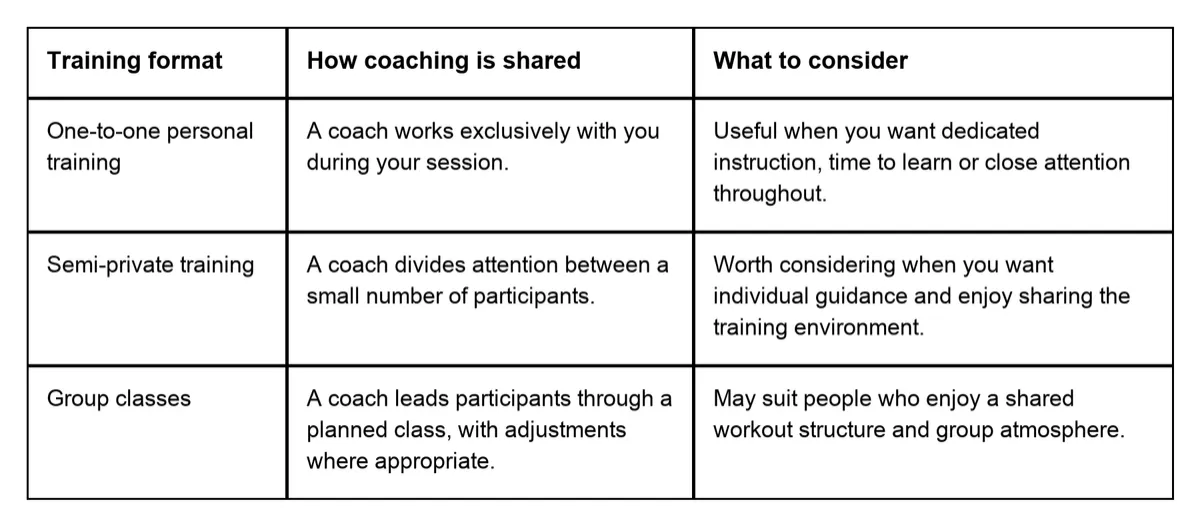
These formats offer different ways to receive coaching. The best fit depends on how much individual attention you want and the environment you enjoy.
A smaller group does not automatically mean better programming. When comparing options, ask how exercises are selected, how technique is coached and how progress is reviewed.
Similarly, “small group personal training” and “semi-private training” are sometimes used interchangeably. Look beyond the name to understand what you will actually receive.
Why Choose Semi-Private Training?
Guidance when you need it
Training independently means making plenty of decisions: which exercise to choose, how much weight to use and when to increase the challenge.
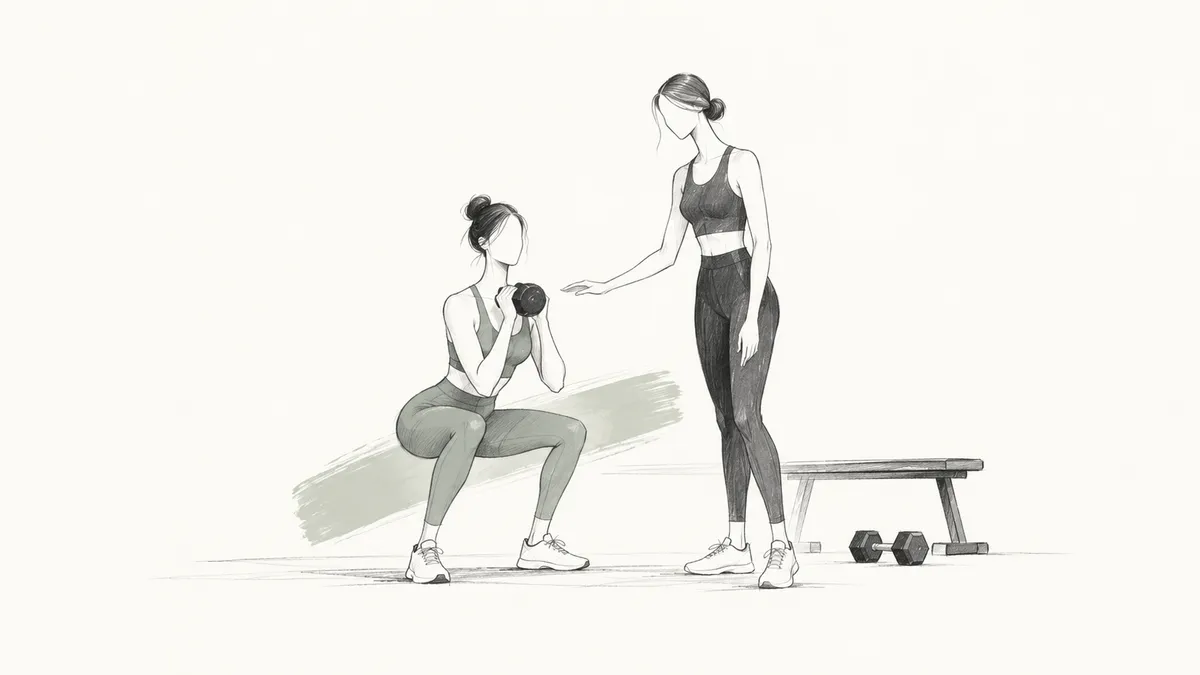
A coach can help you make those decisions. They can observe your movement, offer practical cues and adjust an exercise when the current version is too challenging or too easy.
Over time, that guidance can also help you understand your programme and feel more comfortable using gym equipment.
A routine you can plan around
It is easy for an unplanned workout to disappear from a busy week.
A regular booking gives training a clear place in your calendar. For someone balancing work, family and other commitments, knowing when to arrive can make the routine easier to organise.
Fixed sessions do require some planning, so check that the available times work for you before committing.
Company without needing to compete
Some people enjoy the gym more when they train around others. A small group can offer conversation, encouragement and a familiar environment.
You do not need to match someone else’s weights or fitness level. Your training should remain appropriate for your own starting point.
The aim is to work towards your goals while sharing the experience.
A clearer way to recognise progress
Progress is not always a dramatic change in body weight or appearance.
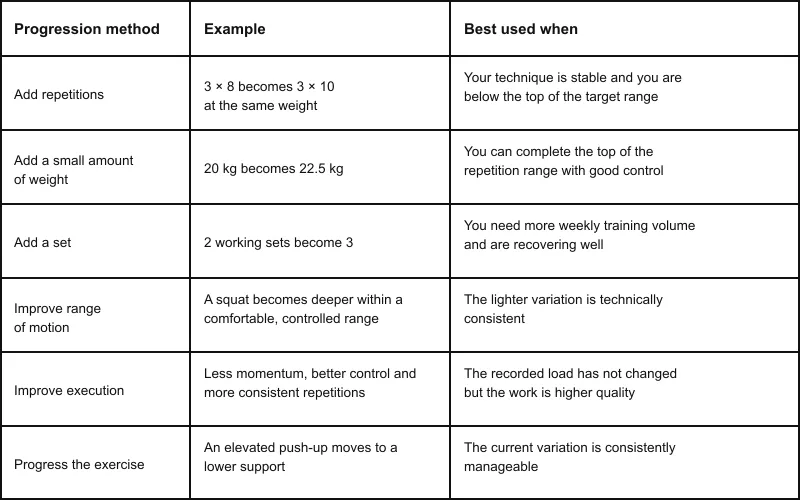
It might mean completing an exercise with more control, using a heavier dumbbell at a similar effort, or attending consistently through a busy month.
Ask how your coach will record and review progress. Having something specific to look back on can make it easier to understand what is improving and what needs adjusting.
Who Might Enjoy Semi-Private Training?
Semi-private training may suit you if:
You want coaching but also enjoy training alongside others.
You are returning to exercise and would value structure.
You already train but feel uncertain about how to progress.
You prefer a smaller training environment.
You can attend regularly at the available session times.
It can also appeal to people who want to develop gym confidence without making every training decision themselves.
However, your starting point matters. If you are completely new to resistance training, you may benefit from learning the basics one-to-one first. ONIT’s FAQs recommend personal training as an initial foundation for new exercisers; the introductory consultation can help identify the most appropriate starting option.
When Might One-to-One Training Be a Better Fit?
You may prefer personal training if you want your coach’s full attention throughout the session, need more time to learn unfamiliar movements, or feel more comfortable training privately.
An injury or medical condition may also affect the type of support you need. Discuss relevant concerns before starting so the team can consider whether a particular format is suitable and whether input from a healthcare professional is needed.
Choosing one-to-one training first does not mean you need to stay with that format forever. Your preferred level of support may change as your skills, confidence and circumstances develop.
What Might a Semi-Private Session Look Like?
The exact session depends on the programme. As an illustration, a coached strength session might include:
A brief check-in:
Discuss how you are feeling and anything that could affect the session.
A warm-up:
Prepare for the movements you will practise.
Main exercises:
Work through selected movements using an appropriate level of difficulty.
Additional work:
Complete exercises that support the session’s goals.
A short review: Record what you did and clarify the next step.
Participants might use different weights, exercise variations or rest periods. Sharing a session does not require everyone to complete identical work.
This is an example of how a session could be organised, rather than a fixed ONIT class plan.
Questions to Ask Before Joining
A useful consultation should help you understand both the training and the practical commitment.
Consider asking:
How will you adapt the programme to my goals and experience?
How many people can attend each session?
How do you track progress and decide when to change exercises?
Would I benefit from one-to-one sessions before joining?
Which session times are available?
What happens if I need to cancel or reschedule?
What does the price include?
Clear answers make it easier to compare options and choose a routine you can realistically maintain.

Frequently Asked Questions
Do I need to be fit before starting semi-private training?
You do not need to reach an arbitrary fitness standard before speaking with a coach. The first step is to discuss your experience and goals. Complete beginners may benefit from one-to-one instruction before moving into a shared session.
Will everyone do the same workout?
That depends on the programme. Some sessions use individual plans, while others share a structure with personalised adjustments. Ask how your exercises and workload will be selected.
Can I train with a friend?
ONIT’s FAQs state that friends or family can book into the same semi-private session, subject to availability. Check available spaces with the team before making plans.
How often should I attend?
The right frequency depends on your goals, current activity, recovery and schedule. Start by discussing a realistic weekly commitment with your coach, including any training you do outside coached sessions.
Is semi-private training cheaper than personal training?
Sharing a coach’s time may reduce the per-person cost, but pricing varies between providers and packages. Compare current prices alongside session length, coaching arrangements and what is included.
Explore Semi-Private Training at ONIT Gym Epping
The right training format should give you useful support and fit into your life.
If you want individual guidance within a small-group environment, semi-private training is worth exploring. If you are unsure where to begin, a conversation with a coach can help clarify your options.
At ONIT Gym Epping, a Free No Sweat Intro gives you the opportunity to discuss your goals, experience and schedule. It is a consultation, with no workout required.
Evidence note:
- Progressive overload is the gradual adjustment of training demand as a person adapts; it does not require adding weight at every workout.
- Both load progression and repetition progression can be viable. One eight-week randomised study of 43 trained adults found broadly similar adaptations between the two approaches, but its short duration and modest sample limit generalisation.
- A large 2023 network meta-analysis found that many resistance-training prescriptions improved strength and muscle growth. Higher-load programs ranked more strongly for maximal strength, while multiple sets were important for hypertrophy.
- Training to momentary failure and complex programming are not consistently necessary for the average healthy adult; regular training and gradual progression matter more.
- Australian guidance recommends muscle-strengthening activity on two or more days per week, but it does not prescribe one universal progression method.
Health disclaimer: This article provides general fitness information only and is not medical advice or an individual exercise prescription. If you have an injury, persistent pain, a medical condition, are pregnant or are returning after a long break, seek advice from an appropriately qualified health or exercise professional before starting or changing your program.
Scientific sources and references
1. Currier BS, D'Souza AC, Fiatarone Singh MA, et al. (2026). [American College of Sports Medicine Position Stand: Resistance Training Prescription for Muscle Function, Hypertrophy, and Physical Performance in Healthy Adults—An Overview of Reviews](https://pubmed.ncbi.nlm.nih.gov/41843416/). Medicine & Science in Sports & Exercise, 58(4), 851–872. DOI: [10.1249/MSS.0000000000003897](https://doi.org/10.1249/MSS.0000000000003897). Why it matters: The updated position stand emphasises consistent resistance training and gradual development while finding that advanced techniques, complex periodisation and momentary failure are not consistently required for healthy adults.
2. Currier BS, McLeod JC, Banfield L, et al. (2023). [Resistance training prescription for muscle strength and hypertrophy in healthy adults: a systematic review and Bayesian network meta-analysis](https://pubmed.ncbi.nlm.nih.gov/37414459/). British Journal of Sports Medicine, 57(18), 1211–1220. DOI: [10.1136/bjsports-2023-106807](https://doi.org/10.1136/bjsports-2023-106807). Why it matters: The strength network included 178 studies and 5,097 participants, while the hypertrophy network included 119 studies and 3,364 participants. All tested resistance-training prescriptions outperformed no exercise, with goal-specific differences in the highest-ranked approaches.
3. Plotkin D, Coleman M, Van Every D, et al. (2022). [Progressive overload without progressing load? The effects of load or repetition progression on muscular adaptations](https://pubmed.ncbi.nlm.nih.gov/36199287/). PeerJ, 10:e14142. DOI: [10.7717/peerj.14142](https://doi.org/10.7717/peerj.14142). Why it matters: In this eight-week randomised trial of 43 resistance-trained adults, increasing repetitions and increasing load produced broadly similar adaptations. It supports repetitions as a viable progression method, although the study was short and relatively small.
4. Grgic J, Schoenfeld BJ, Orazem J, Sabol F. (2022). [Effects of resistance training performed to repetition failure or non-failure on muscular strength and hypertrophy](https://pubmed.ncbi.nlm.nih.gov/33497853/). Journal of Sport and Health Science, 11(2), 202–211. DOI: [10.1016/j.jshs.2021.01.007](https://doi.org/10.1016/j.jshs.2021.01.007). Why it matters: This systematic review and meta-analysis found that training to failure was not required for strength or muscle growth when training volume was accounted for, supporting progressive training without forcing every set to maximal fatigue.
5. Australian Government Department of Health, Disability and Ageing. [Recommendations for adults aged 18 to 64 years](https://www.health.gov.au/topics/physical-activity/24-hour-movement-guidelines-for-all-australians/recommendations-for-adults-18-to-64-years). Why it matters: Current Australian guidance recommends muscle-strengthening activity on two or more days each week as part of an active lifestyle; individual exercise selection and progression can be adapted to the person.