What Is Progressive Overload and Why Does It Matter?
You follow the same workout each week, but after a while it no longer feels as challenging. Should you add more weight, complete more repetitions or change the entire program?
This is where progressive overload matters. It is the principle of gradually increasing the training demand placed on your body as you adapt. The increase should be large enough to provide a useful challenge, but manageable enough that you can maintain good technique and recover for the next session.
Progressive overload does not mean lifting heavier every time you enter the gym. You can progress by adding repetitions, sets or load, improving your range of motion and control, or performing the same work with less unnecessary fatigue. The appropriate method depends on your goal, experience and current program.
This guide from ONIT Gym Epping explains how progressive overload works and gives you a simple system you can use in your own training.
What does progressive overload mean?
When you begin a new exercise, the work creates a stimulus that your body is not fully accustomed to. With appropriate recovery and repeated training, your muscles and nervous system adapt. The same workout may then require less effort than it did before.
Progressive overload means adjusting the training demand over time so that the program continues to provide a reason to adapt. In resistance training, that demand can be changed through variables such as:
- the weight lifted;
- the number of repetitions;
- the number of challenging sets;
- the exercise difficulty or range of motion;
- the quality and control of each repetition; and
- in selected cases, training frequency or rest periods.
Not every variable should increase at once. Progress is easier to measure and manage when you change one element at a time.
Why does progressive overload matter?
It keeps your training challenging enough to produce adaptation
Your body becomes more capable when it is exposed to a suitable training challenge repeatedly. If your program never changes after it becomes easy, the stimulus may eventually be too small to support continued progress.
That does not make an unchanged workout useless. It may help maintain your current ability, reinforce technique or provide an appropriate session during a stressful week. However, if your goal is to keep building strength, muscle or performance, some aspect of the training normally needs to progress over the longer term.
It turns effort into measurable progress
Without a record of your exercises, weights, repetitions and sets, it is difficult to know whether your training is moving forward. Progressive overload gives the program a direction.
For example, completing 10 controlled goblet squats with 16 kg and later completing 12 with the same weight is progress. Moving from 16 kg to 18 kg while returning to 8 controlled repetitions is another step. These small changes are easier to evaluate than judging a session only by sweat or soreness.
It helps you match training to your goal
Different adaptations respond to different programming choices. A 2023 network meta-analysis included 178 studies in its strength analysis and 119 in its muscle-growth analysis. All resistance-training prescriptions improved strength and hypertrophy compared with no exercise, but higher-load programs ranked more strongly for maximal strength, while multiple-set programs were important for muscle growth.
The practical point is not that everyone needs one perfect routine. It is that progression should reflect what you want to improve. A person training for maximal strength may gradually prioritise heavier loads, while someone training for general fitness or muscle growth may progress successfully across a wider range of repetitions and loads.
Progressive overload is not just adding weight
Adding weight is useful, but it is only one option. Here are six practical ways to progress.
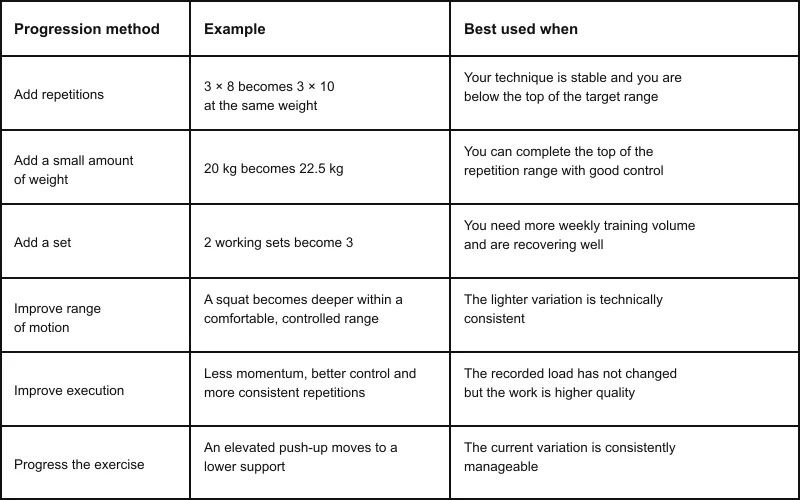
Reducing rest can make a workout feel harder, but it is not automatically the best form of overload. Shorter rest may reduce the weight or repetitions you can complete. Use it deliberately when work capacity is the goal, rather than treating fatigue as proof of progress.
Your training log might look like this:
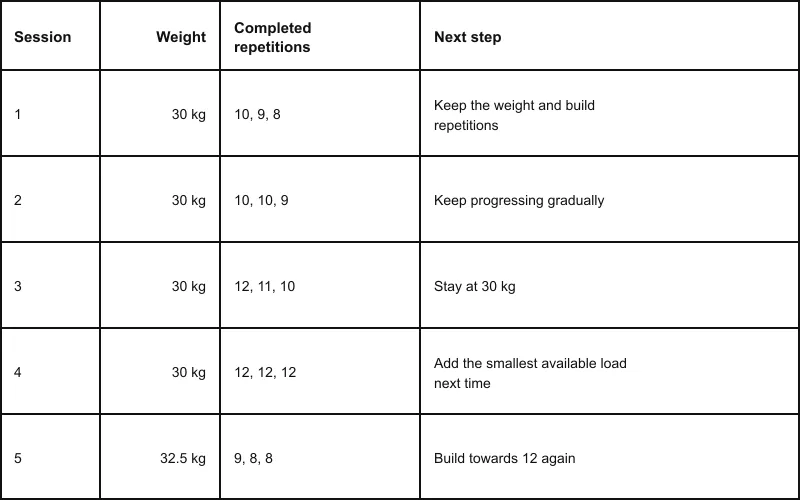
A simple double-progression method
Double progression is an easy system for many gym members because you progress repetitions first, then load.
Suppose your program prescribes three sets of 8–12 repetitions on the seated row:
1. Choose a weight you can control for at least eight repetitions per set.
2. Keep that weight while gradually adding repetitions across sessions.
3. When you can complete 12 repetitions on all three sets with consistent technique and an appropriate level of effort, increase the weight by the smallest practical amount.
4. Return towards the lower end of the range and build up again.
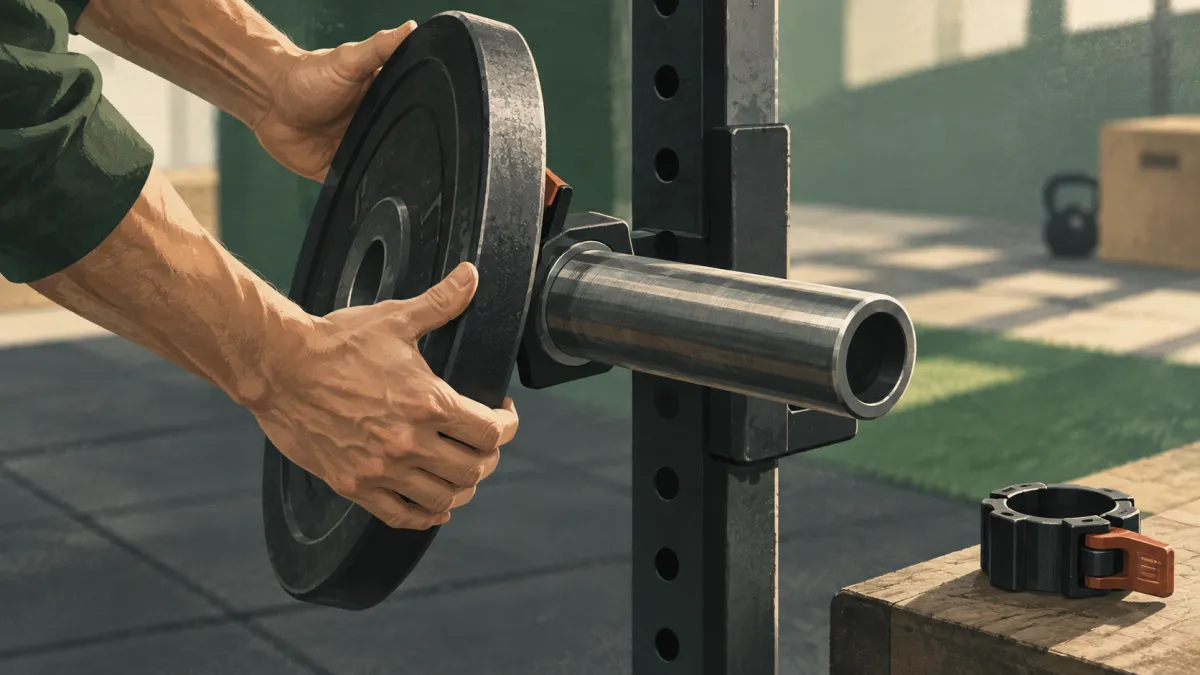
Can you progress by adding repetitions instead of weight?
Yes. An eight-week randomised study compared two progression methods in 43 resistance-trained adults. One group increased load while keeping its repetition target stable; the other increased repetitions while keeping load stable. Both approaches produced similar overall muscular adaptations, although load progression slightly favoured dynamic strength and repetition progression modestly favoured one muscle-growth measure. The differences were generally small and the study was short.
This supports a useful practical choice: you do not have to force a weight increase every week. Adding controlled repetitions can also be a valid form of progressive overload.
How much should you increase the weight?
Use the smallest increase that allows you to keep the intended repetition range and technique. The right jump depends on the exercise and equipment.
A 2.5 kg increase may be small on a leg press but substantial on a shoulder exercise. Dumbbells and machines also have different increments. When the next available weight is too large, add repetitions first, slow down the rush to progress or ask a coach for another suitable variation.
The goal is not to make every session dramatically harder. It is to accumulate small, repeatable improvements over weeks and months.
How often should you progressively overload?
There is no fixed schedule. Beginners may improve repetitions or load relatively often as they learn the movements. More experienced lifters may need several weeks to achieve a small increase.
Your performance can also fluctuate because of sleep, stress, nutrition, illness and other activity. A single difficult session does not mean the program has stopped working. Look for the overall trend across several weeks.
Appropriate progression might mean:
- adding one repetition to one or more sets;
- increasing a weight after several successful sessions;
- maintaining the same performance with cleaner technique;
- holding the program steady during a demanding week; or
- temporarily reducing training demand when fatigue has accumulated.
Progressive training is not perfectly linear. Planned maintenance and easier periods can support longer-term consistency.

Do you need to train to failure to make progress?
No. Training to momentary muscular failure can be used in some programs, but it is not consistently required for strength or muscle growth in healthy adults. The 2026 American College of Sports Medicine position stand also identifies complex periodisation and repeated failure training as optional rather than essential for the average healthy adult.
For many people, finishing most working sets with approximately two or three good repetitions still possible provides a practical starting point. This can help you practise technique and manage fatigue while still training with meaningful effort.
Repetitions-in-reserve estimates are not perfectly accurate, especially for new lifters. Treat the method as a skill that improves with experience, not as an exact measurement.
Common progressive-overload mistakes
Increasing too many variables at once
Adding weight, sets and extra training days in the same week can create a sharp increase in fatigue. Change one main variable, then monitor how you respond.
Sacrificing technique to record a heavier number
A heavier lift with a shorter range of motion or more momentum is not always a meaningful progression. Compare like with like: use the same exercise setup, movement standard and repetition quality.
Progressing every exercise at the same speed
Large lower-body exercises may tolerate bigger increases than smaller upper-body movements. Your exercises will not all improve on the same timetable.
Changing exercises before you can measure improvement
Constant variety can be entertaining, but it makes progression difficult to track. Keep important movements consistent long enough to practise and evaluate them.
Treating soreness as the goal
Soreness is not a reliable measure of whether your program is effective. Training quality, performance, recovery and consistency provide more useful information.
Ignoring recovery
Training provides the stimulus; adaptation also depends on recovery. More work is not automatically better when sleep, nutrition or recovery between sessions is inadequate.
What should you track?
A simple training log is enough. Record:
- exercise and equipment setup;
- load used;
- repetitions completed in each set;
- number of working sets;
- estimated repetitions in reserve or session difficulty; and
- brief notes about technique, pain or unusual fatigue.
Review several weeks rather than reacting to one workout. If the same exercise has not progressed for a while, consider whether the issue is the program, inconsistent attendance, inadequate recovery, an unrealistic target or simply a normal short-term plateau.
When should you ask a coach for help?
Professional guidance may help if you are unsure whether your technique is consistent, cannot decide when to increase the weight, or have been repeating the same program without a clear plan.
A coach can help establish an appropriate starting point, choose useful progression targets and separate a genuine plateau from normal day-to-day variation. If an exercise causes sharp, sudden, persistent or worsening pain, stop and seek advice from an appropriately qualified health professional rather than trying to overload through it.
Build a program you can progress at ONIT Gym Epping
Progressive overload works best when the program is simple enough to track and realistic enough to repeat. Start with appropriate exercises, record what you do and make small changes only when your technique and recovery support them.
At ONIT Gym Epping, our coaches can help you understand your starting point and choose a training approach that suits your goals, experience and weekly schedule.
Book a Free No Sweat Intro to discuss where you are now and what a sustainable next step could look like.

Frequently Asked Questions
What is progressive overload in simple terms?
Progressive overload means gradually making training more demanding as your body adapts. This can involve more repetitions, slightly more weight, an additional set or better execution—not only lifting heavier.
Should I increase weight or repetitions first?
For many members, adding repetitions within a target range before increasing weight is simple and effective. Once you reach the top of the range with consistent technique, increase the load slightly and begin near the lower end again.
Do I need to progressively overload every workout?
No. Progress is not perfectly linear. Maintain your current training when needed and assess the trend across several weeks rather than forcing an increase every session.
Can beginners use progressive overload?
Yes. Beginners can progress by improving technique, adding controlled repetitions and making small load increases. They should avoid changing several variables at once.
What if the next dumbbell is too heavy?
Keep the current load and build repetitions, improve control or use another suitable exercise setup. A coach can also help you find a smaller or more appropriate progression.
Is progressive overload only for building muscle?
No. It is used to develop strength and other aspects of physical performance as well. The most appropriate type of progression depends on the outcome you want.
Evidence note:
- Progressive overload is the gradual adjustment of training demand as a person adapts; it does not require adding weight at every workout.
- Both load progression and repetition progression can be viable. One eight-week randomised study of 43 trained adults found broadly similar adaptations between the two approaches, but its short duration and modest sample limit generalisation.
- A large 2023 network meta-analysis found that many resistance-training prescriptions improved strength and muscle growth. Higher-load programs ranked more strongly for maximal strength, while multiple sets were important for hypertrophy.
- Training to momentary failure and complex programming are not consistently necessary for the average healthy adult; regular training and gradual progression matter more.
- Australian guidance recommends muscle-strengthening activity on two or more days per week, but it does not prescribe one universal progression method.
Health disclaimer: This article provides general fitness information only and is not medical advice or an individual exercise prescription. If you have an injury, persistent pain, a medical condition, are pregnant or are returning after a long break, seek advice from an appropriately qualified health or exercise professional before starting or changing your program.
Scientific sources and references
1. Currier BS, D'Souza AC, Fiatarone Singh MA, et al. (2026). [American College of Sports Medicine Position Stand: Resistance Training Prescription for Muscle Function, Hypertrophy, and Physical Performance in Healthy Adults—An Overview of Reviews](https://pubmed.ncbi.nlm.nih.gov/41843416/). Medicine & Science in Sports & Exercise, 58(4), 851–872. DOI: [10.1249/MSS.0000000000003897](https://doi.org/10.1249/MSS.0000000000003897). Why it matters: The updated position stand emphasises consistent resistance training and gradual development while finding that advanced techniques, complex periodisation and momentary failure are not consistently required for healthy adults.
2. Currier BS, McLeod JC, Banfield L, et al. (2023). [Resistance training prescription for muscle strength and hypertrophy in healthy adults: a systematic review and Bayesian network meta-analysis](https://pubmed.ncbi.nlm.nih.gov/37414459/). British Journal of Sports Medicine, 57(18), 1211–1220. DOI: [10.1136/bjsports-2023-106807](https://doi.org/10.1136/bjsports-2023-106807). Why it matters: The strength network included 178 studies and 5,097 participants, while the hypertrophy network included 119 studies and 3,364 participants. All tested resistance-training prescriptions outperformed no exercise, with goal-specific differences in the highest-ranked approaches.
3. Plotkin D, Coleman M, Van Every D, et al. (2022). [Progressive overload without progressing load? The effects of load or repetition progression on muscular adaptations](https://pubmed.ncbi.nlm.nih.gov/36199287/). PeerJ, 10:e14142. DOI: [10.7717/peerj.14142](https://doi.org/10.7717/peerj.14142). Why it matters: In this eight-week randomised trial of 43 resistance-trained adults, increasing repetitions and increasing load produced broadly similar adaptations. It supports repetitions as a viable progression method, although the study was short and relatively small.
4. Grgic J, Schoenfeld BJ, Orazem J, Sabol F. (2022). [Effects of resistance training performed to repetition failure or non-failure on muscular strength and hypertrophy](https://pubmed.ncbi.nlm.nih.gov/33497853/). Journal of Sport and Health Science, 11(2), 202–211. DOI: [10.1016/j.jshs.2021.01.007](https://doi.org/10.1016/j.jshs.2021.01.007). Why it matters: This systematic review and meta-analysis found that training to failure was not required for strength or muscle growth when training volume was accounted for, supporting progressive training without forcing every set to maximal fatigue.
5. Australian Government Department of Health, Disability and Ageing. [Recommendations for adults aged 18 to 64 years](https://www.health.gov.au/topics/physical-activity/24-hour-movement-guidelines-for-all-australians/recommendations-for-adults-18-to-64-years). Why it matters: Current Australian guidance recommends muscle-strengthening activity on two or more days each week as part of an active lifestyle; individual exercise selection and progression can be adapted to the person.