Personal Training vs Group Training: Which Is Right for You?
Personal training and group training can both help you become stronger, fitter and more consistent. The difference is not that one is always better. It is how the coaching, schedule, training environment and level of individual attention fit your needs.
Some people progress best with one-to-one guidance and a program built around their goals. Others enjoy the energy, routine and shared motivation of training with a group. Many people use both at different stages.
This guide from ONIT Gym Epping compares the two options so you can choose a training format that suits your experience, goals and lifestyle.

What is personal training?
Personal training is a one-to-one coaching service. Your trainer can assess your starting point, discuss your goals and create a program around your experience, schedule and preferences.
During a personal training session, the coach can focus on your movement technique, exercise selection, training load and progression. The session can also be adjusted when your energy, ability or circumstances change.
At ONIT Gym Epping, personal training currently includes:
- a flexible schedule with your preferred coach, subject to availability;
- a program tailored to your individual goals;
- one-to-one coaching and technique feedback;
- help defining realistic goals and tracking progress; and
- guidance designed to support results you can maintain.
What is group training?
Group training is an instructor-led workout completed alongside other members. Everyone follows the planned session, while the coach demonstrates exercises, provides guidance and helps participants train safely within the group setting.
At ONIT Gym Epping, group training is offered at fixed times and is designed to provide:
- structured workouts led by a coach;
- a consistent weekly schedule;
- motivation and accountability from training with others;
- variety across exercises and session formats; and
- a supportive community environment.
Group training is still coached training, but the instructor's attention is shared across the class rather than dedicated to one person.
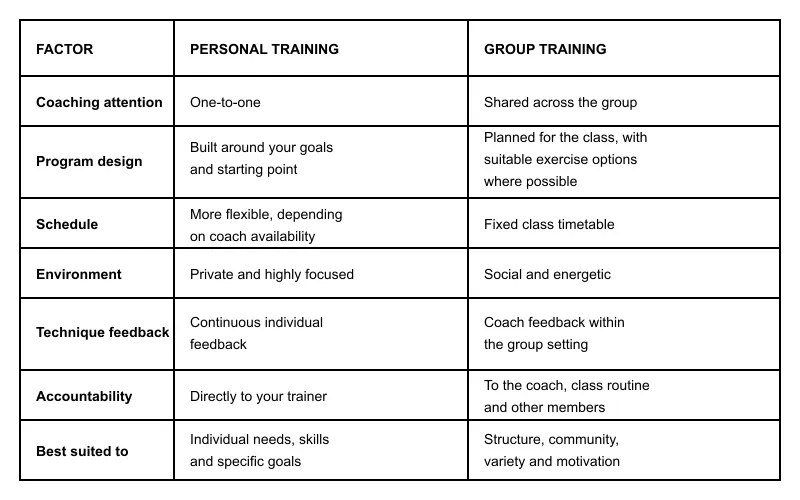
Personal training vs group training at a glance
Perform this workout two or three times per week. Start with one or two working sets of each exercise. Most beginners do well with a weight they can control for 8–12 repetitions, finishing each set with roughly two or three good repetitions still possible.
When personal training may suit you better
You are completely new to the gym
Starting in a gym can feel confusing when you do not know how to adjust equipment, select exercises or choose an appropriate weight. A personal trainer can guide you through these decisions and help you learn the main movement patterns at your own pace.
You do not have to become “fit enough” before working with a trainer. Learning good habits at the beginning may make independent or group training feel more manageable later.
You have a specific goal
Personal training can be useful when your goal needs a more individual approach, such as improving a particular lift, preparing for an event, returning to training after a long break or working around limitations that have already been assessed by an appropriate health professional.
A coach can choose exercises and progression methods that match the goal instead of relying on a general workout.
You want detailed technique feedback
Some movements are easier to learn when a coach can watch every repetition, explain one correction at a time and adjust the exercise immediately. This can be especially valuable for compound lifts or when you are trying to move beyond a training plateau.
Your schedule changes from week to week
If fixed class times are difficult because of work or family commitments, personal training may offer more flexibility. Your trainer can help you create a realistic schedule rather than expecting your week to fit a rigid routine.
You prefer a quieter, focused environment
Not everyone enjoys exercising in a class. If you concentrate better with fewer distractions or feel nervous training around a group, one-to-one coaching may be a more comfortable entry point.
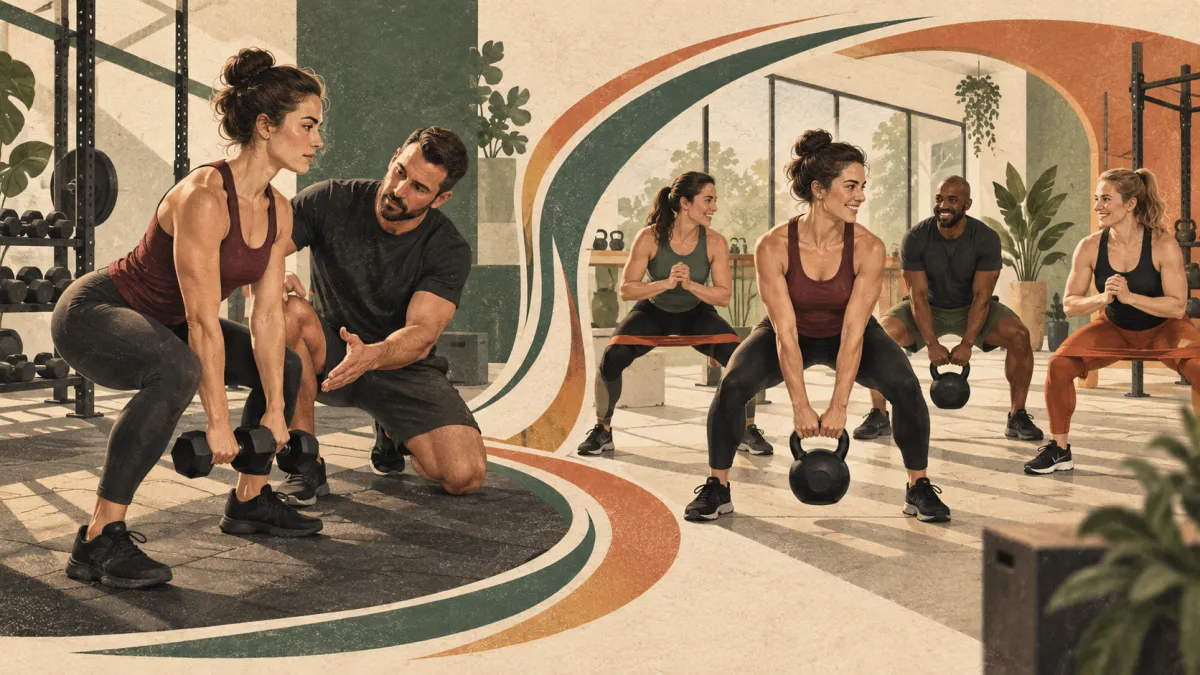
When group training may suit you better
You enjoy training with other people
The social environment can make training feel more enjoyable and help some people keep showing up. Research on exercise adherence suggests that self-efficacy, social connection and instructor behaviour may influence class attendance, although the evidence is varied and much of it is observational.
You want a session planned for you
Group training removes the need to decide what to do every time you enter the gym. The coach provides the structure, demonstrates the session and guides the class through it.
A fixed timetable helps you stay consistent
A class booked into your week can become a useful routine. Some people respond well to knowing exactly when they train and seeing familiar members at the same sessions.
You like variety and shared energy
Group sessions can combine different exercises and formats, helping training feel engaging. The energy of the room may encourage you to work consistently, provided you still choose loads and variations appropriate for you.
You want coached training with shared attention
Group training gives you access to an instructor and a structured program without making the entire session one-to-one. It can be a practical option if you do not need a fully individualised session.
Does personal training produce better results?
Supervision can improve exercise selection, feedback and accountability, but a trainer cannot replace your own consistency. In one 10-week randomised trial involving 79 trained adults, in-person supervised resistance training had higher attendance and larger squat-strength gains than app-guided or self-guided programs. However, that single study does not prove that every person needs personal training or that one-to-one training will always outperform a well-coached group.
The best results usually come from an appropriate program that you complete consistently and progressively. A person who enjoys group training and attends regularly may progress more than someone who books personal training but rarely follows the plan between sessions.
Is group training suitable for beginners?
It can be. A good group environment should explain the session clearly, offer appropriate exercise options and encourage technique rather than competition.
Before joining a class, tell the coach if you are new, returning after a break or unsure about an exercise. It may also help to complete one or more personal training sessions first so you understand the main movements and equipment.
If you have an injury, medical condition, persistent pain or symptoms that may affect exercise, seek appropriate medical or allied-health advice before starting or changing your program.
Can you combine personal and group training?
Yes. Combining the two can offer individual guidance and a regular social routine. For example, you could use personal training to learn technique, review your program and work on specific goals, then use group sessions for additional structured training.
A combined week might look like:
- Monday: personal training focused on strength and technique;
- Wednesday: group training;
- Saturday: group training or an independent session; and
- walking, mobility or other enjoyable activity on the remaining days.
This is only an example. The correct frequency depends on the difficulty of each session, your recovery, training history and other activity.
Five questions to help you decide
1. How much individual attention do you need?
Choose personal training if you want detailed coaching throughout the session. Choose group training if you are comfortable sharing the coach's attention.
2. Do you have a specific or complex goal?
A highly specific goal may benefit from an individual program. A general strength and fitness goal may fit either option.
3. Which environment makes you more likely to attend?
Some people value privacy and direct accountability. Others look forward to seeing the group. Your preference matters because consistency is essential.
4. Do fixed class times suit your week?
Group training works well when the timetable fits your routine. Personal training may be easier if your availability changes.
5. What fits your budget?
Personal training provides dedicated coaching and is generally the higher-cost option. Group training shares the coaching environment and is generally more affordable per session. Check current pricing and inclusions before deciding, as packages can change.
Find the right training option at ONIT Gym Epping
ou do not need to choose based on guesswork. At ONIT Gym Epping, you can discuss your goals, experience, preferred training environment and weekly availability before selecting a program.
Book a Free No Sweat Intro to talk with an ONIT coach. The conversation can help you decide whether personal training, group training or a combination is the most realistic next step for you.
Frequently Asked Questions
1. Is personal training better than group training for beginners?
Personal training provides more individual attention, which can make it easier to learn equipment and technique. A well-coached group can also suit beginners when exercises are clearly explained and appropriate options are available.
2. Is group training good for weight loss?
Group training can contribute to energy expenditure, fitness and consistency, but fat loss is not determined by the class format alone. Nutrition, total activity, sleep and long-term adherence also matter.
3. How often should I see a personal trainer?
There is no single correct frequency. Some people train with a coach several times per week, while others use periodic sessions for technique, program updates and accountability. The right frequency depends on your goals, experience, budget and ability to train independently.
4. Will I receive technique help in group training?
Yes, group training is instructor-led, but the coach's attention is shared. If you need continuous individual feedback or significant exercise modification, personal training may be more suitable.
5. Can I switch from personal training to group training later?
Yes. Training needs can change as your confidence, technique, schedule and goals develop. Some people begin with personal training, move into group sessions and continue occasional one-to-one check-ins.
Evidence note:
- Both personal and group training can support physical activity when the program is appropriate and completed consistently.
- Personal training offers individual program design, direct feedback and flexible scheduling; group training offers structured sessions, social connection and fixed routine.
- Supervised exercise may provide advantages over self-guided exercise in some populations and outcomes, but evidence does not show that one delivery format is universally best for everyone.
- Social belonging, self-efficacy and instructor behaviour may support group-class adherence, but findings vary and much of the evidence is observational.
- Australia's adult movement guidelines recommend muscle-strengthening activity involving all main muscle groups on two or more days per week; they do not require a particular training format.
Health disclaimer: This article provides general fitness information only and is not medical advice or an individual exercise prescription. Personal training and group training may not be appropriate for every condition or injury. Seek advice from a qualified medical or allied-health professional when needed.
Scientific sources and references
1. Australian Government Department of Health, Disability and Ageing. [Recommendations for adults aged 18 to 64 years](https://www.health.gov.au/topics/physical-activity/24-hour-movement-guidelines-for-all-australians/recommendations-for-adults-18-to-64-years). Why it matters: The current Australian guidance recommends muscle-strengthening activity on two or more days per week while allowing people to choose suitable ways to be active.
2. Gavanda S, Held S, Schrey A, et al. [Optimizing Resistance Training Outcomes: Comparing In-Person Supervision, Online Coaching, and Self-Guided Approaches](https://pubmed.ncbi.nlm.nih.gov/40728831/). Journal of Strength and Conditioning Research. 2025;39(11):1129–1137. Why it matters: In this 10-week randomised trial of 79 trained adults, supervised training produced higher attendance and larger squat-strength gains than the app-guided and self-guided conditions; the small, trained sample limits generalisation.
3. Gómez-Redondo P, Valenzuela PL, Morales JS, et al. [Supervised Versus Unsupervised Exercise for Physical Function and Well-Being in Older Adults](https://pubmed.ncbi.nlm.nih.gov/38647999/). Sports Medicine. 2024;54(7):1877–1906. Why it matters: This meta-analysis of 34 trials and 2,830 older adults found possible additional benefits from supervision for selected outcomes, but attendance was similar and stronger evidence is still needed.
4. Gao X, Song YG, Shu Y, Silva AF, Greco G. [Perceived Capability, Social Belonging, and Behavioral Adherence in Adult Group Fitness Classes](https://pubmed.ncbi.nlm.nih.gov/42352717/). Behavioral Sciences. 2026;16(6):882. Why it matters: This review linked class adherence with self-efficacy and some social or instructor-related factors, while emphasising heterogeneous, mainly observational evidence.
5. Rodrigues F, Bento T, Cid L, et al. [Can Interpersonal Behavior Influence Persistence and Adherence to Physical Exercise Practice in Adults?](https://pubmed.ncbi.nlm.nih.gov/30459690/). Frontiers in Psychology. 2018;9:2141. Why it matters: The systematic review supports the relevance of autonomy-supportive exercise professionals while noting the need for stronger longitudinal research.