How Often Should You Go to the Gym Each Week?
Do you need to train every day to see results? For most people, no. The right number of gym sessions depends on your goal, experience, recovery and the amount of work you complete in each session.
For many adults, two to four well-planned sessions per week is a realistic place to start. The most effective schedule is not the one that looks hardest on paper. It is the one you can repeat consistently while still recovering, working and enjoying life.
This guide from ONIT Gym Epping will help you choose a weekly routine that matches your goal.

Start with the Australian movement guidelines
Australia's current movement guidelines recommend that adults include muscle-strengthening activities on two or more days per week, alongside regular aerobic and light-intensity activity. That is a public-health target, not a rule saying everyone needs the same gym program.
Your gym sessions can combine strength, conditioning and mobility. Walking, cycling, sport and active daily life can contribute to your overall movement outside the gym.
How many gym sessions do you need for your goal?
If you are new to the gym: start with 2–3 sessions
Two or three full-body sessions per week give beginners time to practise key movements without making training dominate the week. A simple program may include a squat or leg press, a hinge, a push, a pull, loaded carries and basic core work.
Leave at least a day between demanding full-body sessions when possible. Early progress often comes from improving technique, coordination and confidence—not from doing the maximum amount of exercise.
If your goal is general strength and fitness: aim for 3 sessions
Three weekly sessions can provide a useful balance of training and recovery. You might use three full-body workouts or two strength sessions plus one conditioning session.
A coach can adjust the exercises, sets and intensity so that each session has a clear purpose. Adding more days is only helpful if the extra work improves the program rather than creating fatigue you cannot recover from.
If your goal is general strength and fitness: aim for 3 sessions
Three weekly sessions can provide a useful balance of training and recovery. You might use three full-body workouts or two strength sessions plus one conditioning session.
A coach can adjust the exercises, sets and intensity so that each session has a clear purpose. Adding more days is only helpful if the extra work improves the program rather than creating fatigue you cannot recover from.
If your goal is building muscle: usually 3–5 sessions can work
Muscle growth depends heavily on progressive training and total weekly volume. Research suggests that when weekly volume is matched, simply increasing frequency does not consistently produce more muscle growth. Frequency is mainly a way to organise useful work across the week.
For example, three full-body sessions and four upper/lower sessions can both work. Choose the structure that lets you train each movement with good effort and technique while recovering between sessions.
If your goal is fat loss: do not judge the plan by gym days alone
Fat loss requires an energy deficit over time. Training helps preserve muscle, improve fitness and maintain performance, but adding daily high-intensity workouts is not automatically better.
A practical week may include two or three strength sessions, regular walking or other enjoyable activity, and one or two moderate conditioning sessions. Nutrition, sleep, stress and consistency all influence the outcome.
Is training every day bad?
Daily movement can be healthy, but daily hard training is not necessary for most people. An easy walk, mobility session or relaxed bike ride places different demands on your body than heavy lifting or high-intensity intervals.
If you enjoy attending the gym often, vary the difficulty and purpose of your sessions. Avoid repeatedly training the same muscles hard when performance and technique are getting worse.
Signs that you may need more recovery
One sore day does not mean your program is wrong.
However, review your schedule if you repeatedly notice:
- declining strength or fitness across several sessions;
- soreness that is still limiting your next workout;
- persistent fatigue, irritability or poor sleep;
- joint pain rather than normal muscular effort;
- reduced motivation for several weeks; or
- difficulty maintaining technique with your usual loads.
These signs can also have non-training causes. Persistent pain, unusual fatigue or other health concerns should be assessed by an appropriate health professional.
A realistic weekly gym schedule
Here are three simple examples. They are starting points, not personalised prescriptions.
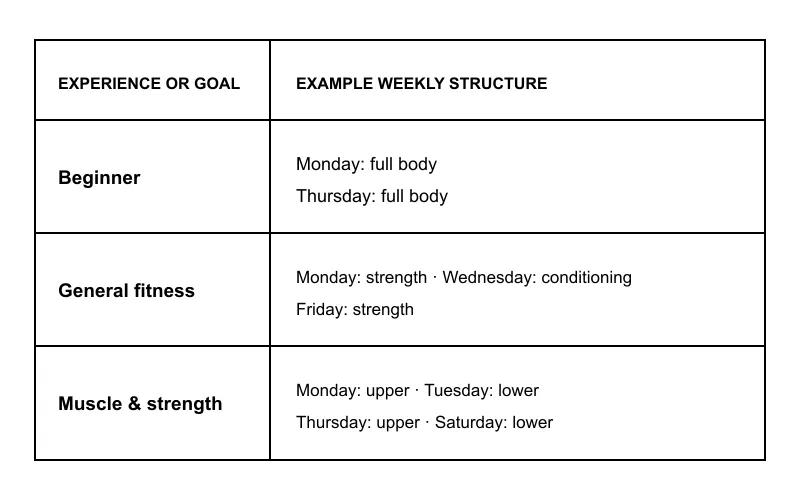
You do not have to train on fixed weekdays. If work or family commitments change, move the session and keep the overall pattern. A flexible plan is often more sustainable than an all-or-nothing routine.

How long should each gym session be?
More time does not always mean a better workout. Many people can complete an effective session in 45–60 minutes when the program is focused. A beginner may need slightly longer at first to learn equipment and movement technique.
The session should be long enough to complete useful work with good form. It does not need to leave you exhausted to be effective.
Common mistakes when choosing training frequency
1. Going from zero sessions to six
A dramatic schedule may feel motivating for one week but be difficult to recover from or maintain. Build gradually.
2. Copying an advanced athlete's routine
Their training history, recovery time and goals may be completely different from yours.
3. Making every session hard
Training should include progression, but not every day needs maximum loads, failure training or intense conditioning.
4. Ignoring what happens outside the gym
Sleep, work stress, sport, manual work and daily activity all affect recovery.
5. Changing the plan before it has time to work
Track your exercises, loads and repetitions. Give a sensible program time to produce a trend before judging it from one workout.

Build a schedule that fits your life
The ideal routine is personal. At ONIT Gym Epping, our coaches help members choose an achievable training frequency, learn safe technique and progress the program as fitness improves.
If you are unsure whether you need two, three or four sessions per week, book a Free No Sweat Intro. We can discuss your goals, training history and weekly schedule before recommending the next step.

Frequently Asked Questions
Is going to the gym twice a week enough?
Yes. Two well-designed strength sessions can be a strong starting point and align with Australia's recommendation to include muscle-strengthening activity on two or more days per week. Your results will also depend on exercise selection, effort, progression and consistency.
Is three gym sessions a week enough to build muscle?
Three sessions can support muscle growth when the program provides appropriate weekly volume and progressive overload. Research indicates that weekly volume matters more than frequency alone when comparing routines with similar total work.
Should beginners do full-body workouts?
Full-body training two or three times per week is a practical option because it gives beginners regular practice with the main movement patterns. Other structures can also work when they are appropriately designed.
Do I need a rest day after every workout?
Not necessarily. It depends on what you trained and how hard the session was. You might perform an upper-body session the day after a lower-body session, or use an easier activity day between demanding workouts.
When should I work with a personal trainer?
A personal trainer can help if you are unsure how to use equipment, need a program for a specific goal, have struggled to stay consistent or want feedback on technique. Medical conditions, injuries and persistent pain may also require clearance or input from an appropriate health professional.
Evidence note: - Australia's adult movement guidelines recommend muscle-strengthening activity involving the main muscle groups on two or more days per week.
- Systematic reviews suggest that higher resistance-training frequency does not meaningfully improve muscle growth or strength by itself when total weekly training volume is matched.
- Frequency remains useful for distributing weekly work, managing session length and supporting good-quality training.
Health disclaimer: This article provides general fitness information only and is not medical advice or an individual exercise prescription. Training needs vary. Seek advice from a qualified professional if you have an injury, medical condition, persistent pain or unusual symptoms.
Scientific sources and references
1. Australian Government Department of Health, Disability and Ageing. [Recommendations for adults aged 18 to 64 years](https://www.health.gov.au/topics/physical-activity/24-hour-movement-guidelines-for-all-australians/recommendations-for-adults-18-to-64-years). Recommends muscle-strengthening activities on two or more days each week as part of a broader movement pattern.
2. Schoenfeld BJ, Grgic J, Krieger J. [How many times per week should a muscle be trained to maximise muscle hypertrophy?](https://pubmed.ncbi.nlm.nih.gov/30558493/) Journal of Sports Sciences. 2019;37(11):1286–1295. This systematic review and meta-analysis found no meaningful frequency effect when training volume was equated.
3. Grgic J, Schoenfeld BJ, Davies TB, et al. [Effect of resistance training frequency on gains in muscular strength](https://pubmed.ncbi.nlm.nih.gov/29470825/) Sports Medicine. 2018;48(5):1207–1220. Higher frequency was associated with more strength gain overall, but the difference was not significant in volume-equated comparisons.
4. Ramos-Campo DJ, Andreu-Caravaca L, Carrasco-Poyatos M, et al. [Split versus full-body resistance training on strength and muscle growth](https://pubmed.ncbi.nlm.nih.gov/38595233/) Journal of Strength and Conditioning Research. 2024. The meta-analysis found similar strength and hypertrophy outcomes when weekly volume was equated.