Why Am I Getting Stronger but Not Losing Weight?
Your lifts are improving. Exercises that once felt difficult now feel controlled. You may even notice that your clothes fit differently—but the number on the scale has barely moved.
Does that mean your training is not working?
Not necessarily. Strength and body weight measure different outcomes. You can become stronger through better technique and nervous-system adaptations before gaining a noticeable amount of muscle. You may also lose some fat while gaining or maintaining lean tissue, producing a smaller change in total body weight than expected.
At the same time, strength training does not guarantee weight loss. If your average body weight and waist measurement remain unchanged over several weeks and fat loss is your goal, your food intake, daily activity and recovery may need attention.
This guide from ONIT Gym Epping explains what could be happening and how to assess progress without relying on a single weigh-in.
The short answer
You may be getting stronger without losing scale weight because:
- your technique and neural efficiency are improving;
- you are gaining or preserving lean tissue while losing some fat;
- water, stored carbohydrate and food in your digestive system are masking a small change;
- you are eating enough to maintain your current body weight, even if your food choices feel healthier;
- changes in appetite or non-exercise activity are offsetting some exercise expenditure; or
- you have not tracked a consistent trend for long enough.
More than one explanation can be true at the same time.
Strength gain is not the same as muscle gain
Muscle growth can contribute to strength, but it is not the only reason you lift more.
When you practise an exercise regularly, you become better at coordinating it. Your nervous system learns to recruit and organise muscle activity more effectively, while your technique, confidence and ability to brace may improve. These changes can increase performance before a large visible change in muscle size occurs.
A systematic review and meta-analysis of 30 randomised trials involving 623 participants found evidence of neural adaptations alongside strength improvements after resistance training. Another meta-analysis found that whole-muscle strength increased considerably more than muscle size across the included studies, supporting the idea that strength is not simply a direct measure of hypertrophy.
This means adding weight to your squat or completing more push-ups does not prove that you have gained an equivalent amount of muscle—or that muscle gain alone explains the scale.
Can you lose fat and gain muscle at the same time?
Yes, this can occur. It is often called body recomposition.
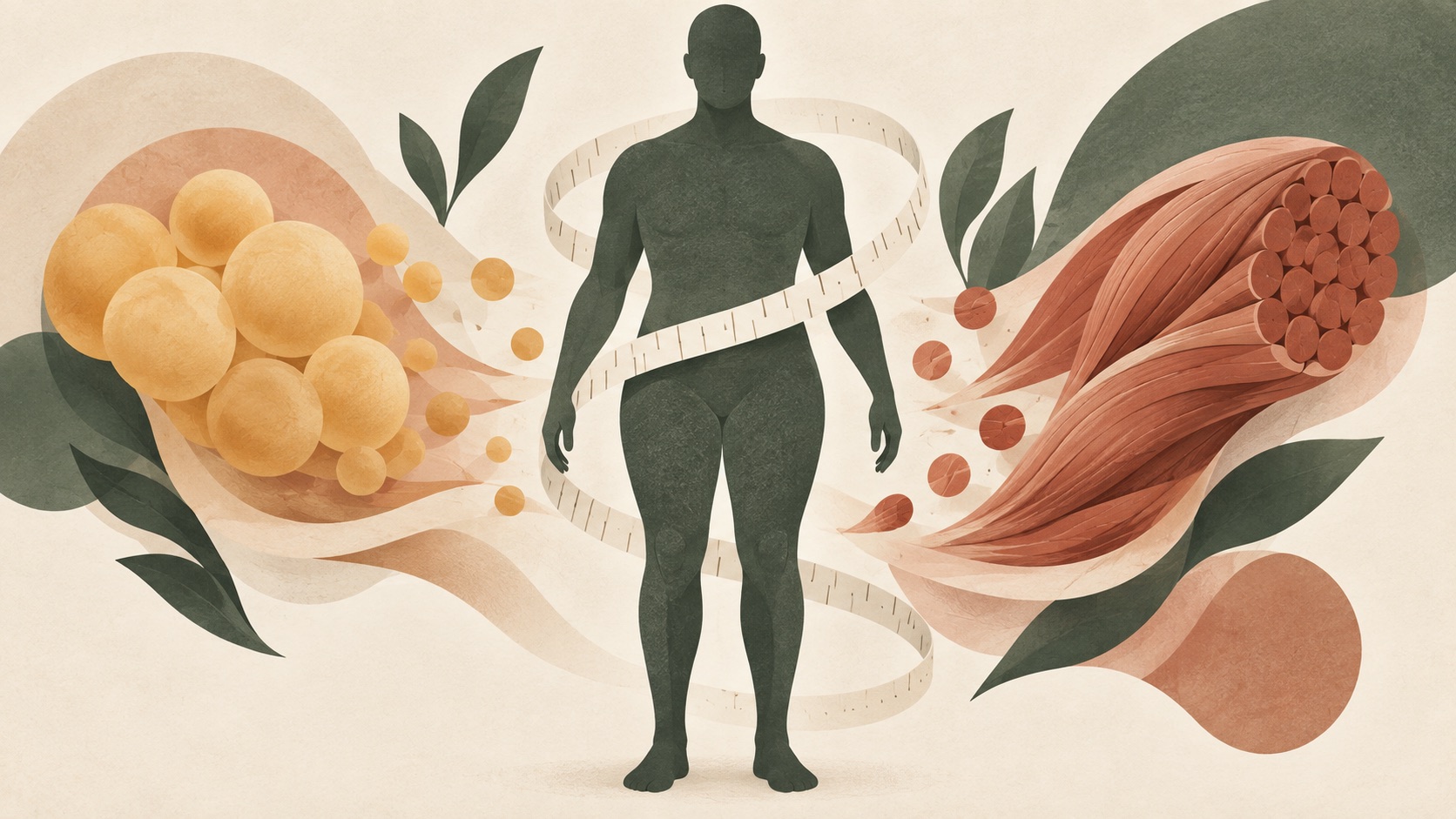
If fat mass decreases while lean mass increases or is preserved, total body weight may change slowly. For example, a reduction in fat mass can be partly offset on the scale by an increase in lean tissue. Your waist, shape, clothing fit and gym performance may improve even when the headline number changes very little.
This is possible, but it should not be used as an automatic explanation for every weight-loss plateau. The amount of muscle gained varies greatly between people and is usually gradual. Training history, program quality, nutrition, genetics, sleep and starting body composition all influence the response.
Evidence supports the possibility of favourable body-composition changes from resistance training:
- A meta-analysis of 54 randomised trials in healthy adults found that resistance training reduced body-fat percentage by an average of 1.46 percentage points and fat mass by 0.55 kg compared with non-exercise controls.
- A separate meta-analysis of 65 trials involving 2,537 adults with overweight or obesity reported an average reduction of 1.6 kg in fat mass and an increase of 0.8 kg in lean mass across resistance-based exercise programs.
These are group averages, not promises for an individual. They also do not mean that everyone will achieve body recomposition while eating without regard to total intake.
Why body weight fluctuates
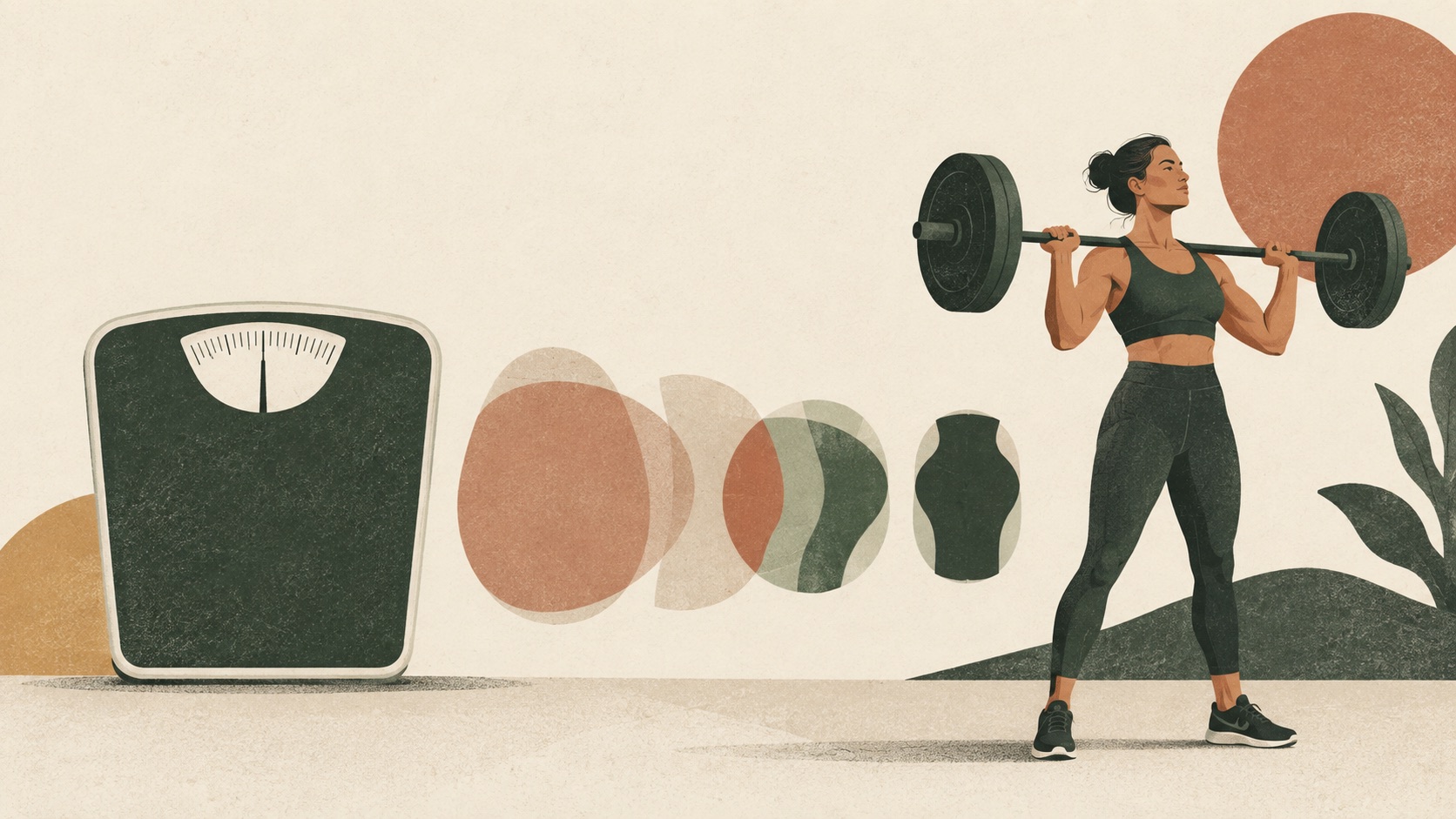
The scale measures your total mass at that moment. It cannot distinguish fat from muscle, water, stored carbohydrate, food or waste.
Water and stored carbohydrate
Your muscles store carbohydrate as glycogen, and glycogen is stored with water. Changes in carbohydrate intake and training can therefore alter scale weight without representing a comparable change in body fat.
A challenging new training session can also cause temporary local inflammation and fluid shifts as your body recovers. This does not mean that strength training has “stopped” fat loss; it means a short-term weigh-in can be noisy.
Sodium, hydration and meal size
For people who menstruate, cycle-related fluid changes can affect interpretation. In one study of 42 women measured twice weekly, body weight was approximately 0.45 kg higher during menstruation than during the first week of the cycle, largely alongside increased extracellular water.
The individual pattern varies. Comparing similar phases across cycles may be more useful than treating one higher reading as a setback.
Creatine supplementation
Creatine can increase water stored within muscle, particularly after supplementation begins. An early scale increase does not necessarily indicate fat gain. If you use creatine, note the start date when reviewing your trend.
Are you actually in an energy deficit?
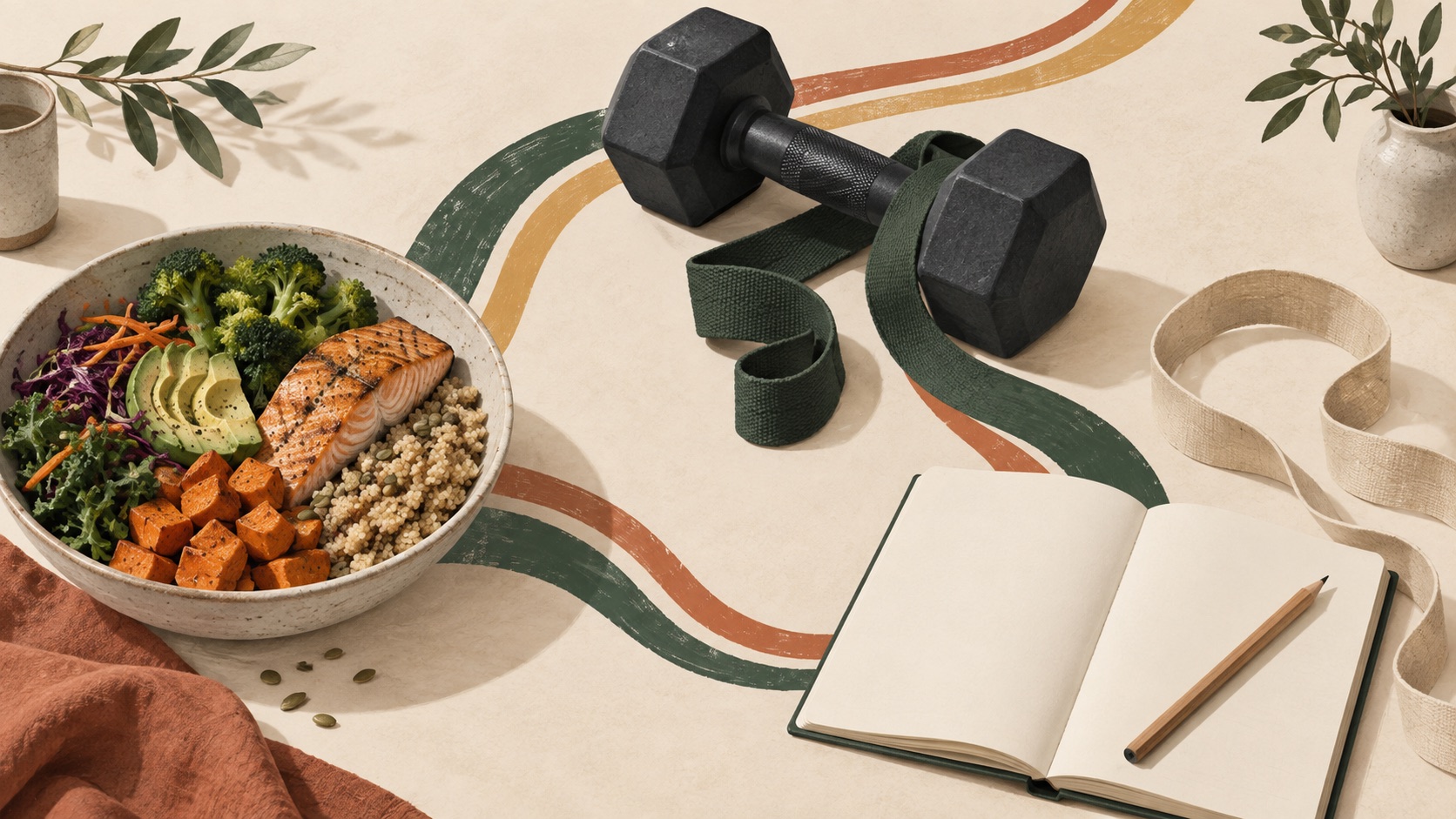
If body-fat loss is the goal, energy intake still matters. Exercise can improve strength, fitness and health without producing a meaningful calorie deficit.
It is easy to underestimate intake from:
- cooking oils, dressings and sauces;
- café drinks, alcohol and weekend meals;
- snacks eaten without much attention;
- larger portions of nutritious but energy-dense foods;
- post-workout hunger; and
- inconsistency between weekdays and weekends.
“Healthy” and “appropriate for fat loss” are not identical. Nuts, avocado, olive oil and protein snacks can all fit a balanced diet, but they still contribute energy.
This does not mean you need an extreme diet or must count every calorie indefinitely. It means that if the longer-term trend is not moving towards your goal, the current combination of intake and expenditure may be close to maintenance.
Exercise calories are easy to overestimate
Wearables and cardio machines provide estimates, not exact permission to eat a particular amount back. People may also compensate for training by feeling hungrier or moving less during the rest of the day.
Avoid treating the displayed calorie number as precise. A more useful approach is to keep training consistent, monitor your real trend and make modest dietary adjustments only when the evidence suggests they are needed.
How to tell what is actually happening
Use several measures over time instead of asking one number to answer every question.
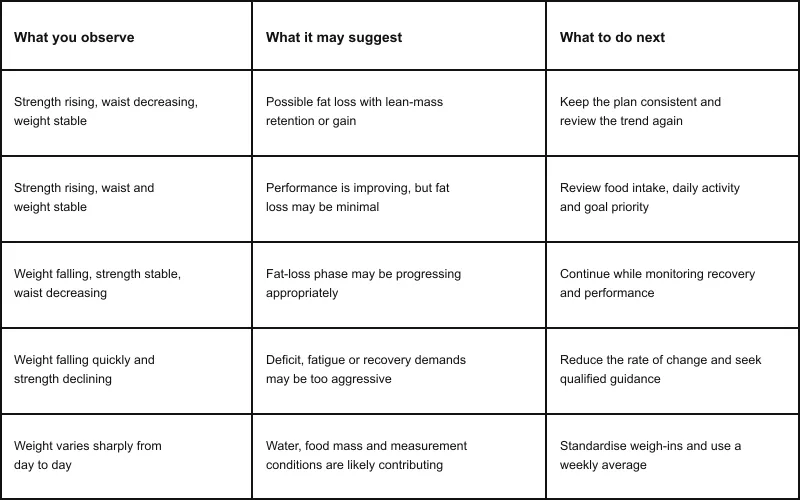
These patterns are clues, not diagnostic tests. Home body-fat scales also have limitations and can change with hydration, so avoid treating a single body-fat percentage reading as exact.
A better way to track progress
1. Standardise your weigh-ins
If weighing is appropriate for you, use similar conditions—such as in the morning, after using the bathroom and before eating. Compare weekly averages rather than individual days.
You do not need to weigh every day. Three or more consistent readings can create a more useful weekly picture. If frequent weighing causes distress or obsessive behaviour, use other measures and seek professional support.
2. Measure your waist consistently
Measure at the same anatomical location, under similar conditions and without pulling the tape tight. Once every two to four weeks is usually more useful than checking every day.
3. Keep a training log
Record exercises, loads, repetitions and sets. This shows whether performance is improving independently of body weight.
4. Use progress photos carefully
Take photos under similar lighting, clothing, distance and posture. Compare changes over several weeks, not from one day to the next.
5. Notice practical outcomes
Clothing fit, energy, sleep, confidence, movement quality and the ability to complete daily tasks can all matter. These do not replace objective measures when fat loss is a specific goal, but they provide a fuller picture.
How long should you wait before changing the plan?
Do not change your diet because of one higher weigh-in. First, collect a consistent trend.
For many people, three to four weeks of reasonably consistent training, eating and measurement provides more useful information than several days. Menstrual-cycle patterns, travel, illness or a recent change in training may require a longer comparison.
If average body weight and waist measurement are not moving after several consistent weeks, consider a small adjustment rather than a dramatic one. Options may include:
- reviewing portion sizes and high-energy extras;
- planning meals more consistently;
- reducing liquid calories or frequent alcohol;
- increasing everyday walking or other sustainable activity; and
- checking that weekend habits align with weekday intentions.
Change one or two variables, then monitor again. Aggressive restriction can reduce training quality, increase hunger and make it harder to preserve lean tissue.
Protein, resistance training and body composition
Adequate dietary protein supports recovery and lean tissue, especially alongside resistance training. A meta-analysis of 49 trials involving 1,863 participants found that protein supplementation produced small additional improvements in strength and fat-free mass during resistance training, with benefits levelling off at around 1.6 g of total protein per kilogram of body weight per day in the study model.
That figure is not a compulsory target for every person, and supplements are not required. Protein needs depend on body size, diet, health, training and whether you are in an energy deficit. A practical starting point is to include a protein-rich food at regular meals and seek advice from an Accredited Practising Dietitian if you want an individual target.
Avoid making the calorie deficit too aggressive
More restriction is not always better. A meta-analysis comparing resistance training with and without an energy deficit found that energy deficits impaired lean-mass gains even though strength gains were broadly comparable. Its meta-regression estimated that a deficit of around 500 kcal per day prevented lean-mass gains on average, but this should not be interpreted as a precise threshold for every individual.
If you are trying to lose fat while training, the goal is usually a manageable rate of progress that allows you to train, recover and eat adequately—not the fastest possible drop on the scale.
Common mistakes when the scale is not moving
Assuming every plateau is muscle gain
Body recomposition is possible, but it should be supported by other signs such as a smaller waist, changing photos or clothing fit—not assumed because the scale is inconvenient.
Cutting food dramatically after one week
Short-term water fluctuations can hide a change. Use a consistent multi-week trend before making a major decision.
Adding more and more exercise
Extra sessions can increase fatigue and hunger without fixing an inconsistent eating pattern. Build a training schedule you can recover from.
Ignoring sleep and stress
Poor sleep and high stress can affect appetite, recovery and training performance. They can also make a plan harder to follow consistently.
Comparing your rate of change with someone else
Starting point, body size, training history, medication, menstrual status and daily life all influence results. Use your own consistent trend.
When should you seek professional advice?
Speak with a GP or qualified health professional if you experience unexplained rapid weight change, persistent swelling, unusual fatigue, dizziness, menstrual disruption, significant digestive symptoms or other health concerns.
An Accredited Practising Dietitian can assess food intake and create an individual nutrition strategy. An appropriately qualified exercise professional can help ensure your training volume, progression and recovery match your goal.
Focus on the trend, not one number
Getting stronger is a real result, even when the scale does not move. It may reflect better technique, neural adaptation, increased lean tissue or a combination of changes.
But the scale should not be dismissed completely when weight loss is the goal. Review average weight alongside waist measurements, training performance and consistent photos. If none of the body-composition indicators change over several weeks, adjust the plan based on evidence—not frustration.
At ONIT Gym Epping, our coaches can help you build a progressive training plan and choose practical ways to monitor your results.
Book a Free No Sweat Intro to discuss your goals, experience and the most realistic next step.

Frequently Asked Questions
Does muscle weigh more than fat?
A kilogram of muscle and a kilogram of fat weigh the same. Muscle tissue is denser and takes up less space, which is why body shape and clothing fit can change without a large change in total weight.
Can I lose fat without losing weight?
Yes. If fat mass decreases while lean mass increases or is maintained, the change in total body weight may be small. Use waist measurements and other consistent indicators alongside the scale.
How long does body recomposition take?
There is no universal timetable. Changes depend on your starting point, training history, food intake, program and consistency. Review trends across months rather than expecting a visible transformation in a few workouts.
Should I stop strength training if my goal is weight loss?
No. Resistance training can improve strength and help preserve lean tissue during weight loss. Nutrition and total activity still need to support the fat-loss goal.
Why did my weight increase after starting strength training?
Early increases can reflect water, glycogen, food mass or normal fluctuation. Some lean-tissue gain may occur over time, but a short-term scale increase should not automatically be labelled as muscle.
Should I eat less if the scale has not changed?
First check several weeks of consistent average weight, waist measurements, food habits and activity. If the trend is genuinely unchanged and fat loss is the goal, a modest adjustment may be appropriate. Avoid extreme restriction and seek qualified advice when needed.
Evidence note:
- Strength can improve through neural adaptation, motor learning and better technique before substantial muscle growth occurs.
- Resistance training can reduce fat mass and increase or preserve lean mass, so body composition may improve with little change in scale weight. Responses vary and body recomposition should not be assumed without supporting measurements.
- Water, glycogen, sodium, digestive contents and menstrual-cycle fluid shifts can obscure short-term trends. One study of 42 women found an average increase of approximately 0.45 kg during menstruation, mainly alongside extracellular-water change.
- Exercise improves health and performance but does not guarantee an energy deficit. If average weight and waist remain unchanged over several consistent weeks, food intake and daily activity may need review.
- During dietary weight loss, resistance exercise helps protect fat-free mass and may improve fat-mass loss even when it does not create additional scale-weight loss.
- Aggressive energy restriction may compromise lean-mass gain and recovery; individual nutrition advice should come from an appropriately qualified professional.
Health disclaimer: This article provides general fitness and nutrition information only. It is not medical advice, a diagnosis or an individual diet or exercise prescription. Seek advice from a GP, Accredited Practising Dietitian or appropriately qualified exercise professional when needed, particularly if you have a medical condition, a history of disordered eating, unexplained weight change or persistent symptoms.
Scientific sources and references
1. Siddique U, Rahman S, Frazer AK, et al. (2020). [Determining the Sites of Neural Adaptations to Resistance Training: A Systematic Review and Meta-analysis](https://pubmed.ncbi.nlm.nih.gov/31993949/). Sports Medicine, 50(6), 1107–1128. DOI: [10.1007/s40279-020-01258-z](https://doi.org/10.1007/s40279-020-01258-z). Why it matters: Across 30 randomised trials involving 623 participants, the review found subtle cortical and subcortical adaptations that may contribute to strength gains, showing why improved strength does not directly measure muscle growth.
2. Wewege MA, Desai I, Honey C, et al. (2022). [The Effect of Resistance Training in Healthy Adults on Body Fat Percentage, Fat Mass and Visceral Fat: A Systematic Review and Meta-Analysis](https://pubmed.ncbi.nlm.nih.gov/34536199/). Sports Medicine, 52(2), 287–300. DOI: [10.1007/s40279-021-01562-2](https://doi.org/10.1007/s40279-021-01562-2). Why it matters: The analysis included 54 studies and found modest average reductions in body-fat percentage and fat mass from resistance training compared with non-exercise controls; individual results still vary.
3. Lopez P, Radaelli R, Taaffe DR, et al. (2022). [Moderators of Resistance Training Effects in Overweight and Obese Adults: A Systematic Review and Meta-analysis](https://pubmed.ncbi.nlm.nih.gov/35977113/). Medicine & Science in Sports & Exercise, 54(11), 1804–1816. DOI: [10.1249/MSS.0000000000002984](https://doi.org/10.1249/MSS.0000000000002984). Why it matters: Across 65 trials and 2,537 participants, resistance-based programs reduced fat mass and increased lean mass on average, supporting the possibility of scale weight understating body-composition change.
4. Kanellakis S, Skoufas E, Simitsopoulou E, et al. (2023). [Changes in body weight and body composition during the menstrual cycle](https://pubmed.ncbi.nlm.nih.gov/37395124/). American Journal of Human Biology, 35(11), e23951. DOI: [10.1002/ajhb.23951](https://doi.org/10.1002/ajhb.23951). Why it matters: In 42 women, body weight was approximately 0.45 kg higher during menstruation, largely alongside a 0.47 kg increase in extracellular water; the small sample means the result should not be treated as a universal amount.
5. Murphy C, Koehler K. (2022). [Energy deficiency impairs resistance training gains in lean mass but not strength: A meta-analysis and meta-regression](https://pubmed.ncbi.nlm.nih.gov/34623696/). Scandinavian Journal of Medicine & Science in Sports, 32(1), 125–137. DOI: [10.1111/sms.14075](https://doi.org/10.1111/sms.14075). Why it matters: Energy deficits impaired lean-mass gains while strength gains were broadly comparable, illustrating why someone may become stronger without building much muscle and why aggressive restriction can conflict with hypertrophy goals.
6. Binmahfoz A, Dighriri A, Gray C, Gray SR. (2025). [Effect of resistance exercise on body composition, muscle strength and cardiometabolic health during dietary weight loss in people living with overweight or obesity: a systematic review and meta-analysis](https://pubmed.ncbi.nlm.nih.gov/40909191/). BMJ Open Sport & Exercise Medicine, 11(3), e002363. DOI: [10.1136/bmjsem-2024-002363](https://doi.org/10.1136/bmjsem-2024-002363). Why it matters: Adding resistance exercise to diet-induced weight loss did not produce more total body-weight loss than diet alone, but it better protected fat-free mass, increased fat-mass loss and improved strength—an important example of why scale weight is not the whole outcome.
7. Morton RW, Murphy KT, McKellar SR, et al. (2018). [A systematic review, meta-analysis and meta-regression of the effect of protein supplementation on resistance training-induced gains in muscle mass and strength](https://pubmed.ncbi.nlm.nih.gov/28698222/). British Journal of Sports Medicine, 52(6), 376–384. DOI: [10.1136/bjsports-2017-097608](https://doi.org/10.1136/bjsports-2017-097608). Why it matters: Across 49 trials and 1,863 participants, protein supplementation produced small additional gains during resistance training, with the model suggesting benefits levelled off near 1.6 g/kg/day of total protein intake.